

I’ll never forget the first time I went to buy a portable generator. I was staring at a wall of boxes, totally confused by the numbers. I just wanted to keep my refrigerator cold and my lights on during the next power outage, but I had no idea what a “watt” was. I almost bought a small model that would have failed the second my fridge’s compressor kicked on.
I learned that before you can power your home—whether with a generator, a new solar setup, or just by understanding your electric bill—you must answer one critical question: “How many watts do you need to power a house?”
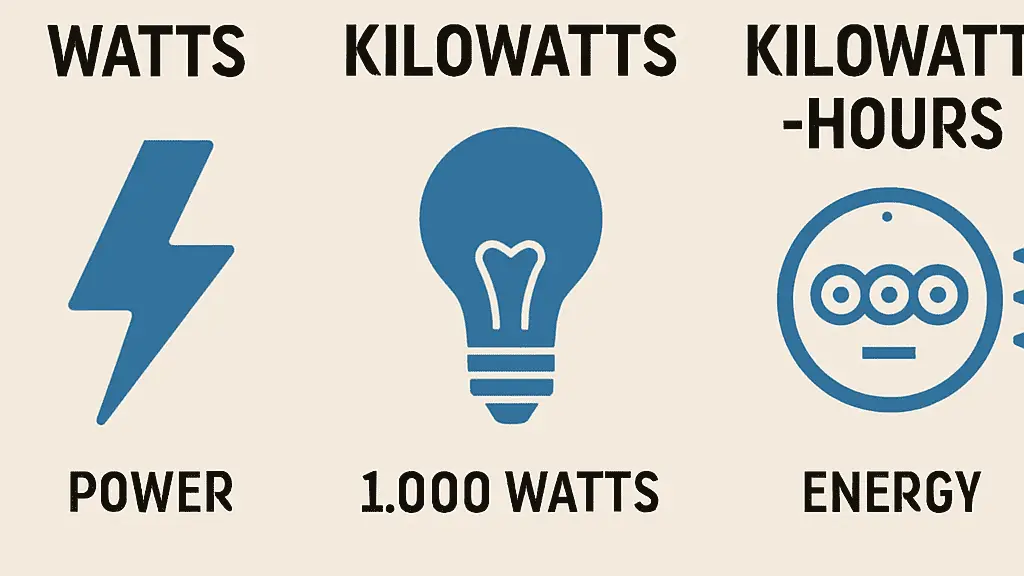
Don’t let the word “wattage” scare you. Think of it simply as “power.” It’s just a number that shows how much electricity an appliance needs to run. A small light bulb might need 60 watts, while a big refrigerator might need 800 watts to start up. Knowing your total wattage is the key to getting the right gear and keeping your home running smoothly.
What is Wattage? (And Why It Matters)
I used to look at the back of my appliances and see numbers like “1200W” and have no idea what it meant. I knew the breaker would trip if I plugged the microwave and coffee maker in simultaneously!
I finally learned that wattage (W) is simply a measure of power.
Think of it this way: wattage tells you exactly how much electricity an appliance needs.
- A small phone charger might only need 5 watts.
- A big, power-hungry microwave might need 1,200 watts to heat your food.
The higher the wattage, the more power the item “pulls” from your wall. Knowing this is the first step to figuring out your electric bill or (like me) buying a portable generator that won’t shut down when you try to make coffee.
Watts vs. Kilowatt-Hours (What You Actually Pay For)
This is the part that confused me for years. My electric bill never said “watts”—it always said “kilowatt-hours (kWh).” Here’s the simple difference I finally learned, and it makes so much sense.
- Watts (W): This is power (how fast you use electricity).
- Analogy: Think of watts as the speed at which water flows from your faucet.
- Kilowatt-Hours (kWh): This is energy (how much electricity you used over time).
- Analogy: Think of kWh as the total gallons of water that have filled up a bucket after an hour.
A “kilo” means 1,000. So, 1 kilowatt-hour (kWh) is 1,000 watts of power used for 1 full hour.
My “Aha!” Moment
Here’s a practical insight: My 1,200-watt microwave uses a ton of power (high watts), but I only run it for 2 minutes at a time.
On the other hand, my 20-watt internet router uses very little power (low watts), but it runs 24 hours a day, 7 days a week.
At the end of the month, that “low-watt” router has used way more total energy (kWh) than my “high-watt” microwave.
This is why your electric bill is in kWh. The power company doesn’t care how fast you use power in one second. They care about the total amount of energy you used all month long. Understanding this is the key to finding what’s really costing you money and managing your energy use.
How Much Power Does a Home Actually Use? (Understanding the Average)
I used to read online that an “average home uses 10,000 watts a day” and I was always confused. Let’s clear that up, because it’s the number one mistake people make.
Remember, “watts” is power, not total energy. You don’t “use watts per day” any more than you “drive miles per hour per day.”
The number you really want is on your electric bill: kilowatt-hours (kWh).
To find the U.S. average, I checked my own bill and then looked up the official data. The average U.S. home uses about 29 kWh per day. That’s 29,000 watt-hours. So that “10,000 watt-hours” (10 kWh) figure you might see? That would be for a very small or efficient home.

Why My Bill Is Different From My Neighbor’s (The 3 Big Factors)
I used to be confused about my electric bill. My neighbor and I have almost the same size house, but he pays way more for power than I do. It made me realize that finding your home’s wattage needs isn’t just about a calculator. It’s about how you live.
Beyond just adding up your appliances, there are three big factors that control how many watts you actually use: your home, your habits, and your hometown.
1. Your Home’s Size and Layout (Are You Heating the Outdoors?)
It’s simple: a huge 5-bedroom house will use more power for heating and cooling than a small 1-bedroom apartment. Those (the heater and the A/C) are the biggest energy vampires in any home.
But it’s not just about size. The layout and build quality of your home make a massive difference.
A Personal Story: My first apartment had old, single-pane windows. In the winter, I could literally feel the cold air leaking in. My heater (a 1,500-watt monster) ran constantly, and my bills were sky-high. My new place has modern, double-glazed windows. It’s amazing. I’m paying less because my heater isn’t working 24/7 just to fight a losing battle with the cold.
Practical Ways Your Layout Helps (or Hurts) You:
- Insulation: This is the #1 hero. Good insulation in your attic and walls means the warm air (or cool air) you paid for stays inside.
- Good Windows: Double-glazed windows act like a buffer, stopping heat from leaking out in winter or creeping in during summer.
- Open Floor Plans: These can sometimes be harder to heat or cool evenly, leading to one person being hot while another is cold.
2. Your Habits (Are You an Energy-Hog?)
This is the “neighbor” factor I was talking about. How many people live in your house, and what are their habits?
More people equals more power. It’s a basic fact.
- More people = more phones to charge.
- More people = more loads of laundry (electric dryers use 5,000+ watts!).
- More people = more hot showers (that electric water heater is a 4,500-watt monster!).
A Practical Insight: I used to think my giant gaming computer was the biggest power-hog in my house. I was wrong. It was my roommate’s 30-minute hot showers. His habit forced our water heater to run for hours every day. My “high-watt” computer, which I only used for a bit at night, was nothing compared to his “high-watt” habit.
Your lifestyle choices are the true driver of your energy bill:
- Do you leave lights on in empty rooms?
- Do you run the dishwasher when it’s only half-full?
- Do you leave the TV on for background noise?
- Do you crank the A/C down to 68°F (20°C) instead of a more efficient 75°F (24°C)?
3. Your Climate and the Season (The Factor You Can’t Control)
Where you live plays a massive role in your energy needs.
- A family in hot, humid Florida might run their central air conditioner (a 3,500-watt machine) for 8 months of the year.
- A family in cold, snowy Minnesota might run their electric furnace (a 15,000-watt beast) for 6 months straight.
Here’s what I do: I look at my electric bill, and it’s a roller coaster. My power use in July (running my 1,000-watt window A/C) is always double what I use in May.
Instead of just being surprised, I adapt to the season:
- In Summer: I close my blinds during the day to block the hot sun. This keeps the room cooler, so my A/C runs less.
- In Winter: I bought a $10 “draft stopper” for my front door. It’s just a cloth tube, but it stops the cold air from sneaking in. This cheap fix saves me a surprising amount on heating.
How to Tally Up Your Home’s Power: A Look at Your Appliances
Knowing how many watts your home uses is like knowing how much gas your car needs. You can’t plan a trip without it! For me, understanding my appliances was the key to saving money and, more importantly, being prepared for a power outage.
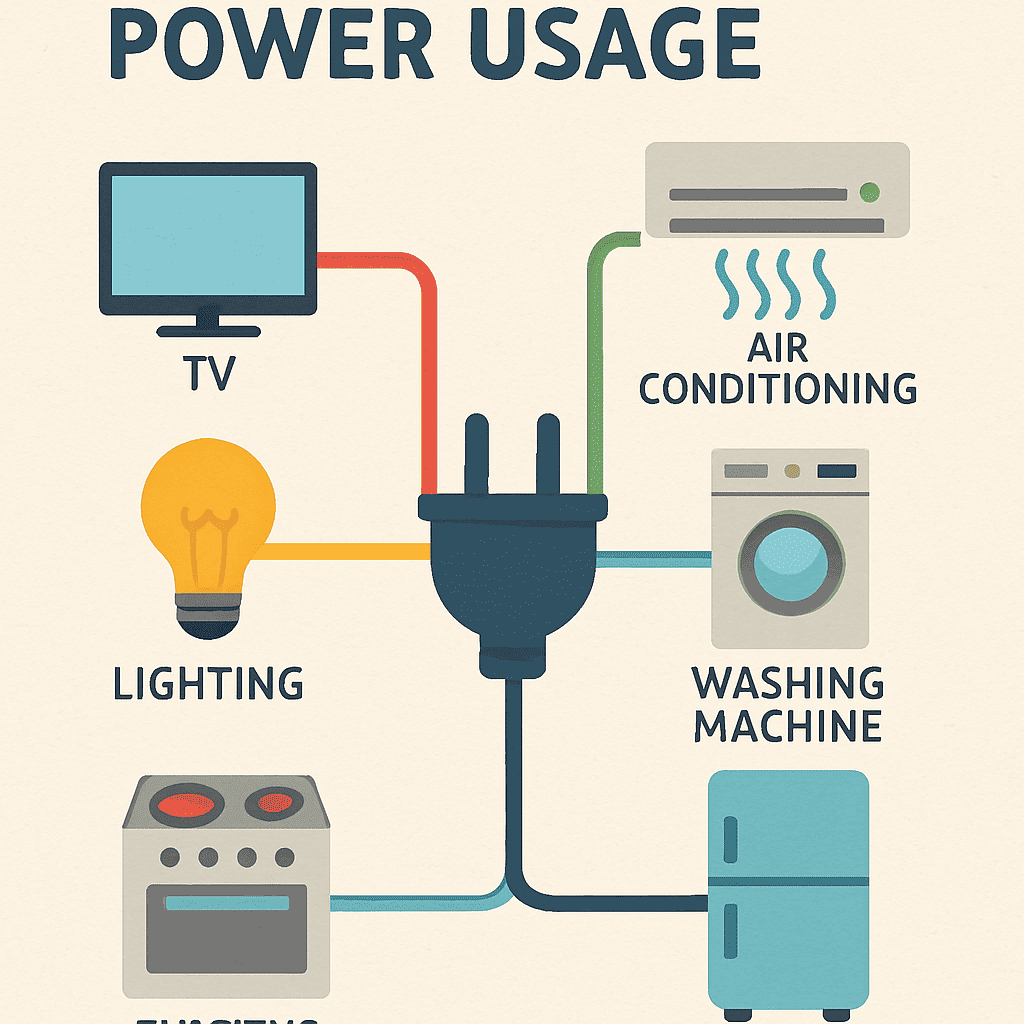
The first thing I learned is that not all appliances are created equal. Some are tiny “energy sippers,” while others are giant “energy hogs.”
The biggest lesson? Most appliances that heat, cool, or have a big motor use the most power.
The #1 Mistake: Forgetting About “Starting Watts”
Here’s a personal story that will save you a huge headache. I once helped my friend buy a generator. We added up all his “must-haves”: fridge (200W), some lights (50W), and a fan (100W). We thought a small 500-watt generator would be fine.
We were totally wrong.
We forgot about Starting Watts (or “Surge Watts”).
- Running Watts: The low, steady power an appliance uses. (My friend’s fridge ran on 200 watts).
- Starting Watts: The jolt of extra power an appliance needs for 1-3 seconds to turn on its motor. (That same fridge needed 800 watts just to start up!)
The second he plugged in the fridge, the 500-watt generator choked and shut off. He needed a generator that could handle the 800-watt surge.
Here is a simple chart of common appliances. Notice the huge difference between running and starting watts for items with motors.
| Appliance | Average Running Watts (What it uses) | Average Starting Watts (What it needs to turn on) |
| The Hogs (Heating/Cooling) | ||
| Central Air Conditioner | 3,500W | 5,000W |
| Electric Oven | 2,500W | 2,500W (no surge) |
| Hairdryer | 1,500W | 1,500W (no surge) |
| Electric Water Heater | 4,500W | 4,500W (no surge) |
| The Surgers (Motors) | ||
| Refrigerator | 200W | 800W |
| Sump Pump | 800W | 1,300W |
| Washing Machine | 700W | 2,000W |
| The Sippers (Electronics) | ||
| Microwave | 1,000W | 1,000W (no surge) |
| Modern TV | 100W | 100W (no surge) |
| LED Light Bulb | 10W | 10W (no surge) |
| Phone Charger | 5W | 5W (no surge) |
My Top 3 Practical Tips for Your Appliances
- Look for the Blue Sticker: When you shop, find the blue Energy Star logo. This is a simple, no-brainer way to know you’re buying a model that uses less power and will save you money.
- Hunt for “Phantom Loads”: I was shocked when I got a small power meter. My TV, cable box, and game console were pulling 30 watts even when they were turned off! This “phantom load” was on 24/7. My fix? I plugged them all into one power strip. Now, I hit one switch, and they are truly off.
- Do Easy Maintenance: You don’t need to be a pro. Once a year, I pull my fridge out and vacuum the dusty coils on the back. When those coils are clean, the fridge doesn’t have to work as hard, which means it uses fewer watts.
How to Calculate Your Home’s Wattage Needs (Two Simple Ways)
Okay, let’s get your “magic number.” Don’t worry, the math is easy.
It’s important to know you’re looking for two different numbers: one for picking a generator (Peak Watts) and one for understanding your electric bill (Watt-Hours).
Method 1: How to Find Your Peak Wattage (For a Generator)
Use this method to find out the biggest amount of power you’ll need at one time.
- Step 1: Grab a notepad. List only the essential items you need to run during a power outage. (e.g., Refrigerator, 5 lights, Phone Charger, CPAP machine).
- Step 2: Next to each, write its Running Watts. Add them all up.
- Example: Refrigerator (200W) + Lights (50W) + Charger (5W) = 255 Total Running Watts.
- Step 3: Now, look at your list and find the single highestStarting Watts number.
- Example: The refrigerator’s 800 Starting Watts.
- Step 4: Do the Math.
- (Your Total Running Watts) + (Your Highest Starting Watt) = Your Total Need
- 255W + 800W = 1,055 Watts
- My Pro Tip: I always add a 20% “buffer.” So, I’d look for a generator that can handle at least 1,200 watts. This ensures the generator isn’t running at 100% all the time, which is much better for its engine.
Method 2: How to Find Your Daily Energy Use (For Your Bill)
Use this to understand how much power you use over a whole day. This is what your electric company bills you for in kilowatt-hours (kWh).
- The Hard Way: Take an appliance’s watts, multiply by the hours you use it, and divide by 1,000. (e.g., 1,000W microwave x 0.25 hours a day / 1000 = 0.25 kWh). Doing this for every item is a huge pain.
- The Easy Way (My Method): Just look at your electric bill.
- Find the “Total kWh Used” for the month. (Let’s say it’s 900 kWh).
- Divide that number by 30 (days in a month).
- 900 kWh / 30 days = 30 kWh per day.
Here is a simple, SEO-friendly rewrite of that content, filled with personal anecdotes and practical insights.
How I Cut My Power Bill: My Favorite Tips for Energy Efficiency
I’ll never forget the month I got an electricity bill that was almost double the usual. I had no idea what I’d done differently. That shock was what kick-started my mission to find all the ways my home was leaking energy.
Reducing your power use is fantastic for your wallet, and it’s great for the environment. The best part? You don’t have to sit in the dark to save money. It all starts with a few smart changes.
1. The “Easy Wins” You Can Do Today
- Hunt for “Phantom Loads”: This was my biggest “aha!” moment. I learned that many devices are never truly “off.” Your TV, your coffee maker, your game console—they all sit in “standby” mode, sipping small amounts of power 24/7.
- My Practical Solution: I bought a few cheap power strips. My entire entertainment center (TV, soundbar, game console) is plugged into one. When I go to bed, I flip one single switch, and I know they are all using zero power.
- Be Smart with Lights: My dad always told me to turn off lights when I leave a room. He was right! This is the simplest habit to build.
2. The Smart Upgrades (That Pay for Themselves)
- The LED Bulb Swap: This is the easiest, fastest upgrade you can make.
- My Personal Insight: My old kitchen lights used 60-watt incandescent bulbs that got hot. I replaced them with 9-watt LED bulbs. They give off the exact same light, use way less power, and last for years. I swapped five bulbs and cut my lighting energy use by over 80% right there.
- Look for the Blue “Energy Star” Logo: When my old washing machine finally gave out, I only shopped for models with the Energy Star sticker. These products are certified to use less energy and water than standard models. It might cost a little more upfront, but it saves you money on every single bill for the next 10+ years.
3. The “Big Projects” for Serious Savings
- Get a Smart Thermostat: This was a game-changer for me. I programmed mine to lower the heat while I’m at work all day and then warm the house up 30 minutes before I get home. Why pay to heat an empty house?
- Insulation is Your Best Friend: This isn’t a “fun” upgrade, but it’s probably the most important. Good insulation in your attic and walls is like wrapping your house in a warm coat. It keeps the heat in during winter and the hot air out during summer. Your A/C and heater will run so much less.
The Next Step: Making Your Own Power (Renewable Energy)
After I did everything I could to reduce my power use, I started looking into how I could reduce my dependency on the power company. This is where renewable energy comes in.
Solar Panels: The Most Popular Choice
I’ve spent a lot of time researching solar panels. The idea of my roof making electricity for me is amazing.
- The Reality: The initial installation cost can be high. It’s a big investment.
- The Practical Insight: You have to think of it as a long-term plan. Over 10-15 years, the system pays for itself in bill savings. After that, you’re getting free power from the sun. Plus, it can significantly increase your home’s value.
Other Powerful Options
- Wind Turbines: In my small neighborhood, this isn’t an option. But for people with rural homes and open land, a small wind turbine can be an incredible way to generate power.
- Geothermal: This uses the stable temperature of the earth to heat and cool your home. It’s super-efficient but also a major installation project.
The Real Game-Changer: Battery Storage
To me, this is the most exciting part. What happens when your solar panels aren’t working (like at night)? A home battery system (like a Tesla Powerwall or many others) stores all the extra power you made during the day.
You can then use that stored power at night, or—even better—you can keep your lights and refrigerator on during a power outage.
Adopting renewable energy is a big step, but it’s the ultimate way to:
- Create a truly sustainable home.
- Lower your carbon footprint.
- Stop worrying about rising electricity prices.
Frequently Asked Questions About Powering a House in Watts
What is the average power consumption in watts for a household? A typical home uses about 10,000 to 15,000 watts daily. This can vary based on several factors.
How do I find out how many watts my appliances use? Most appliances have a label indicating wattage. Alternatively, consult the user manual for this information.
Can improving my home’s insulation reduce wattage needs? Yes. Better insulation helps maintain temperature, reducing reliance on heating and cooling systems.
Is switching to LED lighting effective for saving watts? Switching to LEDs can significantly cut down on power usage due to their lower wattage requirements.
What role do smart home systems play in energy consumption? Smart systems allow monitoring and optimization of power usage, thus contributing to efficiency.
Consider these common inquiries regarding household wattage:
- Average household wattage requirements
- Appliance wattage identification
- Energy-saving strategies through insulation
- Benefits of energy-efficient lighting
- Impact of smart home systems on energy use
Accurate answers to these questions enable better management and understanding of home energy consumption.





Leave a Reply
You must be logged in to post a comment.